Why I failed out of Grad School

Simply put: a series of bad decisions. The first being, I have always struggled with distance learning and believed that my own motivation to succeed in the program would be enough to get me through. It would seem that I was wrong.

The online courses, while I was able to get through them with passing grades, did not provide me with a lasting foundation of learning for me to utilize in real-world application. Each course had the requirements of textbook reading, essay writing, and discussion posting and responding. I did well enough in these requirements, but there was little to no opportunity for any real and actual conversation about areas in which I was perhaps, struggling.

The program required attendance to two separate residencies. These were essentially set up as two day-long conferences. To my benefit, I was able to attend these online. To my detriment, I was later told that going to the in-person residencies were more hands-on and beneficial to the students. Students were able to ask meaningful and personal questions and receive productive answers.

When I began my internship, I simultaneously began what was called a seminar. Seminar was a weekly, live class with a small group of my cohort. This was a more individualized opportunity to learn how to apply our learning. This was a course in which we would practice and prepare ourselves for our final graduation project/test, a complete and comprehensive assessment, diagnosis, and treatment plan of a real client we were to be working with, all through the lens of a specific chosen theorist. This project also needed to include rule-out diagnoses, cultural considerations, application of the code of ethics and local laws. We did sections of this project each week and would turn in and receive feedback and edits to apply. In my seminar, because I was the last person to present my mock project, I did not receive all the feedback to my sections before the course ended. And due to complications with my internship site, I was essentially held back and placed in a new seminar course. I was also put on a specific, weekly one-on-one meeting session with my advisor for specific tutoring.

My internship site was probably my biggest detriment. While my internship supervisor was aware of my requirements, he did not try very hard to ensure I was meeting those requirements. I was not receiving weekly supervision meetings with him, I was not anywhere near meeting my required direct care hours, and I was not given any long-term clients. On multiple occasions I considered leaving and finding a new internship site, and on multiple occasions my supervisor promised me changes in how my internship experience would be run to ensure I was able to meet my requirements, and on multiple occasions those changes either never happened or failed to produce results.

The other struggle I came across was miscommunication between all parties. My program routinely told me to advocate for myself and my needs, and yet, whenever I did to my supervisor my concerns did not seem to be taken seriously. When my supervisor requested things from me, I was sent off on my own to accomplish these and always got them wrong. Instead of attempting to help me get them right I was sent off to try again without help or mentorship and he then would claim this as me not doing my assignments and coming to meetings unprepared. After my required year of internship, which had been extended due to not meeting the requirements I needed for my program, I was let go from the internship.

Following that, I was also dismissed from the program essentially due to an inability to apply my academic learning to real-world situations. After being let go at my internship, the program directors had a hearing for me. During this hearing I was entirely alone without any corroborating advocacy to my difficulties. When asked how it was I held myself accountable for these difficulties after each answer I was responded to that it sounded like I was simply playing the victim. And perhaps this essay portrays the same thing. What I was not made aware of was that the hearing panel was not interested in me defending myself, they wanted me to tell them how I would maintain a positive image for the school. It was deemed that the school was unable to do anything further to help me complete the program and it was unanimously voted for my dismissal.

This is the story of why my situation appears unusual. I had been enrolled in and excited to complete a Forensic Psychology program. The program turned out to be simply a Clinical Mental Health Counseling program with three elective courses dedicated to forensic topics, not forensic counseling methods. My experience with my previous program was an astounding blow to my life, my goals, and my self-esteem towards what I had previously felt an extreme passion for doing.
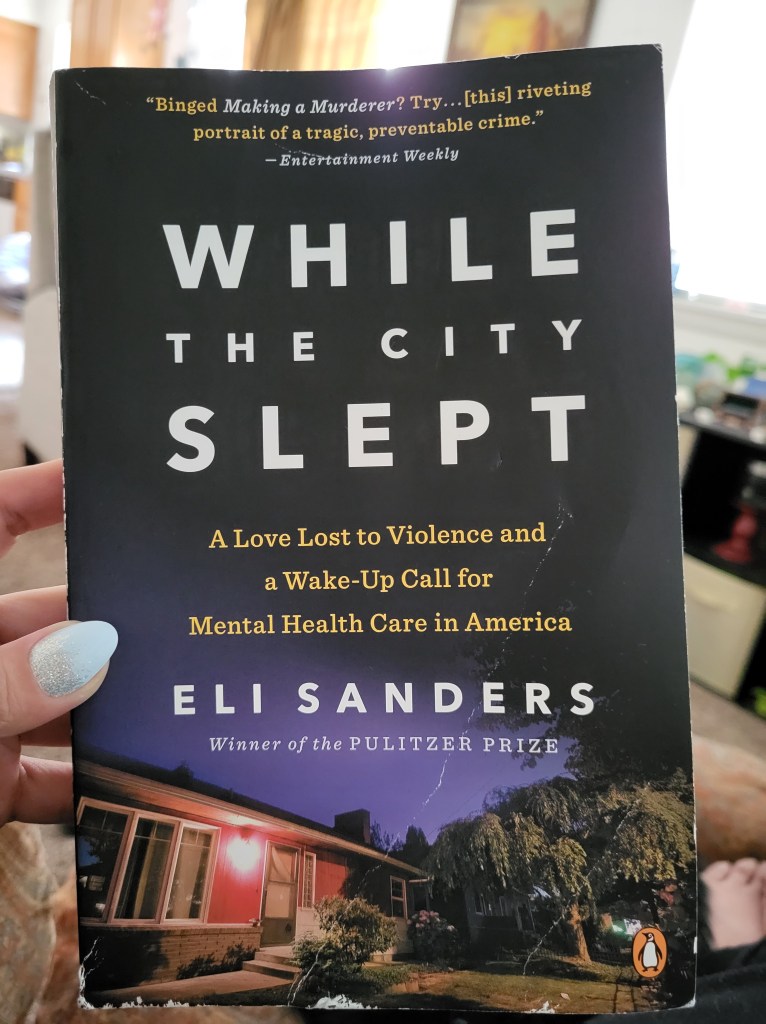

While the City Slept

I read a lot of books like this, and in truth, I do start to get them all mixed up. Because it is always the same story. Always the same justice system failing. And I especially hate it when the added factor of mental health is brought into the mix.
While the City Slept, by Eli Sanders, is uncomfortably detailed. Thorough detail into the victim’s histories. And just as thorough detail into the crime. And you feel scared, and angry, and heartbroken.
And at the heart of this story, is just how preventable this horrendous crime could have been. One of the horrible truths about this nation is its fear of mental health. How people just don’t want to look at it or think about it. If we don’t acknowledge it, it’s not there, right? When the truth is, nobody, NOBODY is immune to mental health problems. But when nobody wants to acknowledge that it is a problem, money begins to get pulled from the mental health systems, rather than go into it. Without resources, our most severely sick are not getting treatment, or the same chance at a stable life that the rest of us get. Without resources, our most severely sick end up in prisons, rather than treatment facilities. And that is an absolutely unjust place for them.
This book is still haunting me a little bit, because I absolutely get it. I feel it, and I am just as upset.

The Problem with Mental Health

A woman named Ellen Baxter goes to a mental institution to visit her mother. What she sees startles her. Her mother sits in a wheelchair, her speech is incredibly slurred, and she is clearly, heavily over medicated.

This was a moment described in an episode of the podcast Invisibilia, from NPR. This is the stereotypical example everyone thinks of when they hear “mental institution.” People drooling, with their heads tilted awkwardly to the side, eyes glazed over. It is a scary thought. This sort of image is the reason “mental institutions” have such a negative and frightening stigma.

But I work in a psych unit, and it’s not like that. My patients don’t drool, and they don’t have glazed over eyes.

This episode of the podcast is dedicated to the idea of solving problems. It begins with a family of a million girls, and the horrible, but inevitable issue of drain hair. And how they managed to find a solution to vastly easier drain cleaning. It is just a quick example of the innovation and ability to solve even the most obscure problems. But at about the 6 minute 15 second mark of the episode, we get to the meat of the matter. We hear Ellen Baxter’s story.

Ellen actually ran from home, and her mentally ill mother the first chance she got. She went to college and became a psych major. Influenced by her visit to the institution where her mother was, she made it her mission to find a more humane way to treat mental illness. She put herself through the experience most people would be too afraid to do. She fakes a mental illness and gets checked into an institution. While most people are probably suddenly hearing the Eagles song Hotel California, Ellen only stayed for one week. One week was enough time for her to see and understand that there really wasn’t any useful therapy provided to the patients. When asked what the patients did all day then, Ellen answered that they watched TV, they stared out the window, and they waited for the bell to ring. The bell that tells them it’s medication time, that tells them it’s snack time… She said she could “almost see the humanity of the people evaporating.”

And the more I thought about this description, the more I realized it actually sounded uncomfortably close to the day-to-day of the unit I work on.

I graduated college with a bachelors in Psychology also. I think I also had a deep seeded desire to help people. To help find a way to guide them through their most personal struggles. I am not a nurse, so I can’t give my patients medications. So I have to work twice a hard to find ways to help them through their crisis. Whether it is a cup of double bagged chamomile tea to help ease their anxiety, a warm blanket to ease their fear, a shower to burn off some steam, or just someone to talk to. I had decided a long time ago that the most important thing was to see each person as an individual rather than a patient, to remember that they are at possibly the lowest point of their lives, and to remember that, for some of them, this is the first time they will have someone who is there to support, and listen to them. And if I can’t do anything else for them, I can certainly listen to them, and to remind them that they are still worthy of someone’s attention.

Ellen Baxter sat down and did some research to find a place where “dependent and disabled people were not thrown away.” What she finds is a town in Belgium called Geel.

This town has an extraordinary way of dealing with its mentally ill population. They are taken into the homes of the towns folk and cared for. The obvious question that burned on Ellen’s mind, and probably many many others was, isn’t it a burden?

Every single host family she asked said, “no.” Apparently this tradition had gone back all the way to the 1300’s. For the towns folk, this way of life is just normal. The mentally ill of the town are treated as any other member of the town. And while hosting some of these individuals can be difficult at times, they do not see it as being any more difficult than dealing with an outburst by someone who is not deemed mentally ill.

What made these towns folk so different in their treatment of the mentally ill, is simple acceptance. They do not see mental illness as something than needs fixing. The host mother allows her boarder to nervously twist the buttons off his shirt, and each night she would sew them back on. While this seems tedious, she is not burdened by doing it. This is just an aspect of who this man is, and she accepts it. The man who hallucinates lions coming out of the walls, his host mother would simply chase the lions away, and the man feels relief.

While it’s easy to imagine how this method with the mentally ill could fail in so many ways, somehow it is managing to work. Maybe allowing each mentally ill person to remember that they are human has some benefits.

It is certainly something I see less and less on my own unit. I see it less in the community as a whole. Mental health has such a negative stigma, it is treated as almost a death sentence. While individuals gain the label of “mentally ill,” along with it seems to hang the label “doomed,” and society turns its back on them. It breaks my heart to see how little funding there is for mental health resources, how alone people suffering from mental illness feel, and how scared they are to seek help.

I think what makes a town like Geel so successful is that the mentally ill aren’t taken somewhere to be hidden like a stain from society, they aren’t taken somewhere with the expectation of walking out the doors “fixed,” they are taken somewhere to be supported and treated as a human.


These were only my thoughts on the first half of the podcast. There is a whole other half hour continuing Ellen’s mission for the humane treatment of the mentally ill.

Here is a link to the full podcast episode. The Problem with the Solution.


Here is a link from NPR exploring the episode deeper, with links and resources.

https://www.npr.org/2016/07/01/483859375/explore-the-episode


Here is a link to an article written by Angus Chen for NPR on the town of Geel and this boarding program, titled For Centuries a Small Town has Embraced Strangers with Mental Illness.

https://www.npr.org/sections/health-shots/2016/07/01/484083305/for-centuries-a-small-town-has-embraced-strangers-with-mental-illness

Mad World

Just watched this movie, Mad World, and it was really good.
Working where I do, mental health isn’t a mystery to me. I understand it, but for a lot of people, it is the invisible illness. People would rather not acknowledge it. And sometimes, entire countries fall into that category.
This movie, about a Chinese man with Bipolar Disorder, shows how other countries views on mental health can be extremely different from ours. After being discharged from a mental health facility, he is unable to reintegrate into society. He is seen no better than a murderer released from jail.
But, first and foremost, this movie is about a man’s struggles with Bipolar Disorder. Having been discharged from the facility, he moves in with his estranged father. The tension between them is obvious. The father, while wanting to make ammends for his absence, does not know how to care for and understand his son. We see the, “just take your medications,” and the, “why can’t you just TRY to be happy,”s that are the textbook responses of someone who truly doesn’t understand mental illness.
Through out the film we are peppered with the young man’s memories of taking care of his ailing mother. Abandoned by his brother and father, he alone was left to do it. And it is extrordinarily difficult for him. Perhaps burdened by the tradition of respecting and taking care of elders, he refused to place her in a home. Just as the father is burdened with the choice of sending him back to the facility, and risk their relationship forever, or continuing to try and care for him himself.
This film opens one’s eyes a little bit into the world of mental health. How it’s not easy, how disruptive it can be to one’s life. And how important it is to have love and support for those who suffer from mental illness.

The Dark Side of Mental Health..

I work in a Behavioral Health unit. The psych unit of the hospital. We get alot of patients, from major mental crisises, to unmanageable depression. The object is to help someone out of their crisis and hope they don’t have to come back.

But there will always be the patients who come back. The ones who count on us to help them, the ones who need us.

Because of that, there are patients that we get to know. We see them when they are at their worst, and we nurture them back to stability. We come to love them, in our way.

In a way, they begin to become like old friends. And each time I discharge them, I give a kick in the pants, and tell them I better not see them round these parts again… And then I give them a hug, and tell them that seriously, we will always be here if they need… And then they are gone.

And days go by, and weeks, and months. For most people, it is, out of sight out of mind. The doors of our unit revolve too quickly to dwell. But for those who have the softest parts of my heart, I imagine I haven’t seen them because they are doing so well in the world. I don’t let my mind imagine the worst.

But sometimes it happens. We live in a small town. And when I happen upon the news article declairing one of my most special patients dead… a piece of my heart breaks away.

There are downsides to every situation, but this is the very worst part of my job. Everybody dies, it is something a hospital is very familiar with, but when one of my patients dies, it cuts me as a failing.

Why didn’t you come to us for help?

I am not a doctor. I’m not even a nurse. I am the person who gets you coffee, who sets up and cleans the shower, the person who wakes you up in the morning, the person who tells you that the sun is out and if you’re not quick, you’ll miss it! I can’t take away your problems, or your pain. All I can do is offer my hand when you’ve fallen, and try my damnedest to help you remember how to smile.

And today, I pushed myself to get up, to go out and see the sun, to smile… because I would never be able to do that for you again. I smiled, because I would never see you smile again..

Super Heroes

We are built of the same stuff Super Heroes are built of. We want to heal the world. We have hearts that care. And though maybe not every battle is meant to be won, we do whatever it is we can. We take stock in the fact that we cared. That for a fraction of a lifetime, if only for that fraction of a lifetime, we gave people moments of compassion. And maybe they have never known one to care for and fight for their future. It is what makes us mighty. We are not given the tools to cure the ails we face every day, but we work with the moments we are given. We invest in their future and show them that they are not alone. They always say to leave work at work, but no one ever says anything about when work leaves you. When that door closes we do not simply shut off. We keep every life we touch, maybe not up front and present, but in the back on a shelf, full of cases, of lives. It is what gives us the strength to keep caring. What drives us to heal the world. What makes us the Super Heroes we are.. And that is something that I truly believe..